One extra word could get this postcard destroyed
You could tell home you were alive. You could not put it in your own words. One wounded soldier found a way to say more.
First, read what survived
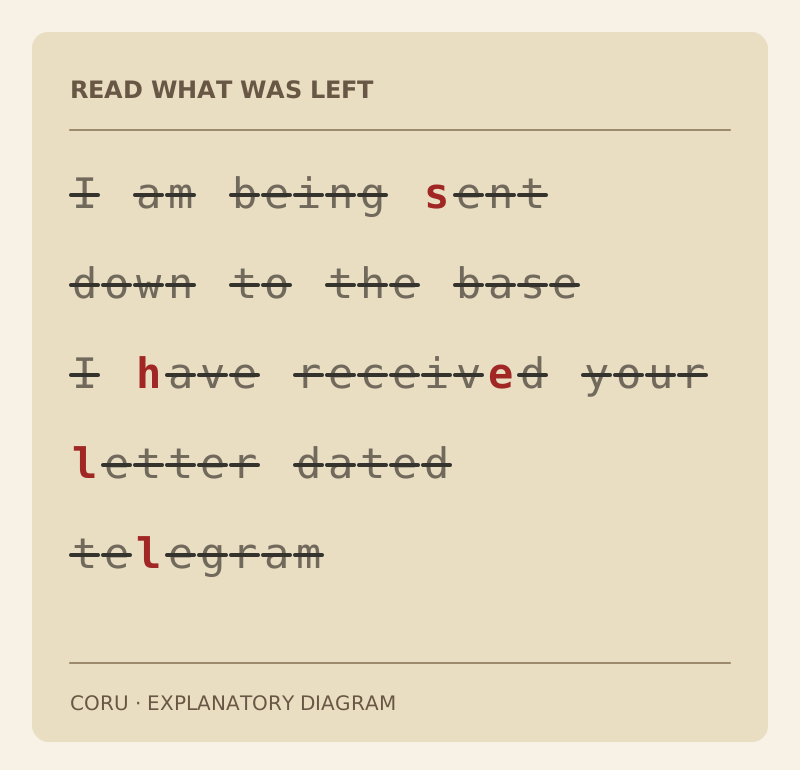
This is not a damaged text. Look at the gaps in the crossing-out: five letters survive among the printed phrases. Read them from top to bottom, left to right. They make one word. We have typeset the lines again so that you can inspect them on a phone. This is a Coru explanatory diagram based on National Museums Scotland’s decoding, not a photograph or a facsimile of the card. The colour is ours.
What did he report?
If the buttons are unavailable, read the surviving letters. The answer and explanation are below in “Five letters were enough”.
Answers and explanations
- A bullet: These letters do not spell bullet. Look inside the words, not just at their beginnings.
- A shell: SHELL. That is how National Museums Scotland explains the message.
- Illness: The form allowed him to report illness, but the concealed word here is SHELL.
Answers and explanations
- A bullet: These letters do not spell bullet. Look inside the words, not just at their beginnings.
- A shell: SHELL. That is how National Museums Scotland explains the message.
- Illness: The form allowed him to report illness, but the concealed word here is SHELL.
To send a message, delete
Imagine a message in which you cannot write “I miss you”, “I’m frightened” or “don’t worry”. On a British Field Service Postcard of the First World War, the useful statements were already printed. The sender crossed out what did not apply, signed and dated it. His job was to leave behind some of somebody else’s text. The form let him report that he was well, had gone into hospital, or had received a letter or parcel. A surviving card warns at the top that extra writing will mean its destruction. That is the rule printed on the card, not evidence that every offending card was actually destroyed. The restriction had a practical purpose. The National Army Museum explains that ordinary letters underwent censorship, while the postcard’s limited wording allowed it to bypass that process. Less freedom for the sender meant less text to check.
Five letters were enough
A postcard from the Scottish soldier C. J. Murray to Mrs Beattie in Falkirk, dated 1 June 1916, reported that he was in hospital. But Murray also wanted to explain his wound. National Museums Scotland’s teaching collection shows how he kept individual letters alive inside the crossed-out phrases. The answer is SHELL: s from sent, h from have, e from received, l from letter and l from telegram. He did not write a new word on the card. He assembled one from the words already supplied. The museum reads this as a concealed message about how he had been wounded. Five letters cannot tell us which part of his body was hit, how serious the injury was or what happened to him afterwards. Here we know his manoeuvre, not his whole life.
A greeting beside the prohibition
Another surviving card complicates the rule. The National Army Museum holds one sent by G. H. Minn from Gallipoli in December 1915. Beside the printed prohibition are two handwritten words: Christmas Greetings. We have not discovered an act of defiance. The museum explicitly says that seasonal greetings were permitted during the festive period. So a story claiming that absolutely nothing could ever be added would be too neat. Even this tightly controlled form had an exception.
Who wrote the message?
The printer supplied the sentences. The army set the boundaries. The sender decided what to erase. Yet between the strokes, his own voice appeared. For Murray it took five letters. For Minn, two permitted words. And somebody at home first needed that small piece of card to arrive: its very existence meant that, on the date beside it, someone had still been able to sign his name.
